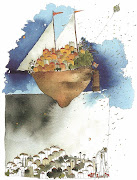
Vivemos em arquipélagos.
Cada um na sua ilha, na sua família, nas suas convicções, nos seus movimentos, julga assim preservar a sua liberdade e segurança. Na verdade a liberdade só começa quando saímos da nossa ilha, e partilhamos com os outros o que é nosso.
18.10.15


8.2.15

11.12.14
A morte e renascimento de Camões.
Após o final da Guerra Peninsular, num momento em que Portugal estava exangue e
vivia
em regime de protetorado inglês, com o rei no Brasil, Camões veio ao de cima.
Em 1817, o Morgado de Mateus criou a monumental edição ilustrada de "Os
Lusíadas", na
oficina de Firmin Didot, em Paris.
Em 1818, o compositor João Domingos Bontempo, criou a obra-prima "Missa de
Requiem a
quatro vozes, à memória de Camões
Em 1824, o pintor exilado Domingos António de Sequeira, expôs no Salão de Paris
"A
Morte de Camões de que se conserva o cartão no MNAA.(foto)
Em 1825 Almeida Garrett publica o poema "Camões", que inicia o
movimento romântico na
literatura, tal como as obras anteriores na musica e pintura.
A todos, as fortes estrofes de Camões ofereciam a expressão do pessimismo mas
também
o tónico de esperança .
E eram tais certezas que levavam o Morgado de Mateus a publicá-lo, Bontempo a
tocá-lo,
Sequeira a pintá-lo e Garrett a cantá-lo. Quatro em um...
5.3.14
Mario Joseph, o imã que encontrou o Cristianismo no Corão
Mario Joseph, o imã que encontrou o Cristianismo no Corão
Mario José era um imã aos 18 anos. Em seguida, tornou-se cristão e o seu pai tentou matá-lo. Hoje, é um pregador católico na Índia. O seu caso é único no mundo: é o primeiro clérigo muçulmano a ter abraçado o Cristianismo, o que no mundo islâmico é punível com a morte. No cemitério da sua cidade indiana, há uma lápide com o seu nome, e por baixo dele, um caixão com uma escultura de barro de seu tamanho. O pai disse-lhe: "Se quiser ser um cristão, tenho que matá-lo."
Mario José era um imã aos 18 anos. Em seguida, tornou-se cristão e o seu pai tentou matá-lo. Hoje, é um pregador católico na Índia. O seu caso é único no mundo: é o primeiro clérigo muçulmano a ter abraçado o Cristianismo, o que no mundo islâmico é punível com a morte. No cemitério da sua cidade indiana, há uma lápide com o seu nome, e por baixo dele, um caixão com uma escultura de barro de seu tamanho. O pai disse-lhe: "Se quiser ser um cristão, tenho que matá-lo."
9.2.14
Um outro mundo - A obra de Cecília Pinto

“La vraie vie est absente” - Arthur Rimbaud
A pintora não está cá….. Mas à nossa frente desfilam como filigranas de um outro mundo os desenhos de um mundo que agora volta à luz pela dedicação de seus filhos Ana e João Pico…
A pintora não está cá….Mas à nossa frente estão os seus desenhos a branco e negro ... Estão as aguarelas de tons subtis, os óleos … e mesmo as fotos de esculturas que ficaram por terras da América.
Olhamos para os retratos que ela pintou e que nos olham de dentro das coisas...
Retratos de família, sobretudo, intimidades que fizeram sentido para quem as viveu mas que de tão poderosamente retratadas, evocam o nosso reconhecimento….
Auto retratos…. Bastantes… Porque reconhecer-se é missão de uma vida inteira e uma imagem autêntica de nós é um dos poucos presentes limpos que podemos oferecer …
E vemos surgir telas e aguarelas com profusão de temas …
Grupos de música de câmara e orquestras … Porque a música é o que mais falta faz ao mundo …Porque evoca os dezasseis violinos que havia em sua casa onde seu pai era músico e lutier.
Grupos sentados em cafés com rostos a que faltam olhos …. Não porque não vejam …mas porque o que de mais importante há para ver está ausente.
Casarios em tons suaves que se erguem nas margens de rios e ribeiros que descansam o nosso olhar… Idílios que gostaríamos de ver transpostos na selva urbana…
Muitos cavalos porque o mundo é movimento … Algumas flores de vez em quando … Poucas …. Que o mundo raramente é risonho.
E depois as cores.. Sempre maravilhosas ... Sempre trovões de cores que explodem em harmonia mesmo que os tons sejam suaves
E podemos continuar a ver … Caricaturas e cartoons onde se nota o gosto da pintora pelo concreto, dos tempos de hoje e do passado. Pelo tempo de Napoleão, da revolução francesa.
E nem faltam as notas políticas com os comentários contra o omnipresente salazarismo que tiranizava os portugueses. Ou contra as touradas. Contra o pensamento único, afinal
Os especialistas dirão das influências de mestres na obra de Cecília Pinto cuja existência discreta e cuja missão secreta é agora resgatada pela Ana e João.
Mas a todos nós pertence a sua inspiração de que um outro mundo é possível.
A pintora não está cá … Mas a sua obra, sim, e continua a inspirar-nos ….
Agosto de 2011
Após revisitar com a Nazaré Barros, a obra de Cecília Pinto
Mendo Henriques
30.1.14
CXXXIX (Re) Leituras -- Die Philosophie des Judentums, de Julius Guttmann, comments by André Bandeira

Finally, what is a jew? And why does one pose the question?
There is some room for meaning. One knows that one which some fit guys, with
brown shirts on and funny caps, expressed, shouting and yelling, with clubs in
their hands, in the thirties, in Germany. And one knows what was the meaning
when a medecine doctor, in the prophet’s tombs, decided to shoot his
machinegun, at random, on the arab worshipers. But, in between, there is
“jewishness”, “jewish blood”, “jewish nose and ears”,”jewish culture”,
“semitic”, “semitism”, “Synagogue of Satan”, “sionism”, etc. Guttmann tells us,
in this Treatise, that Religion is one thing, and Philosophy is another. It is
the most capable History of jewish philosophy I ever read and a very keen
History of the main philosophers with a jewish religious background. But
finally, is there a “jewish philosophy”, or is there philosophy made by jews?
Guttmann never lived up to write a “Theology of Judaism”. It would be interesting
to see how a theological reasoning – yes, because Guttmann, despite being an
orthodox jew, he was a rationalist – would impact in Philosophy. After reading
the book, I think that the religious life of the jewish diaspora, did impinge
in its own tribalization, but that, mostly because of the isolation jews have
been condemned to, by its neighbours. It wouldn’t have been unimaginable that
jewish religion spread beyond the diaspora ethnic boundaries. As a matter of
fact it did, with the Kazar in Russia and with the Falasha, in Ethiopia, the
most conspicuous among several cases. But it also did, in a way, with all
christians. All christians may be considered a kind of jews. In a few
sentences: Guttmann defines judaism as a kind of Religion which has philosophical
implications. Guttmann was an Historian of Philosophy, with a philosophical
expertise. But, whether Judaism has philosophical implications or not, that question
doesn’t mean that judaism is a philosophy. Judaism has been so much penetrated
by Platonism, Aristotelism, Kantian philosophy or existencialism, as
Christianity was. As a matter of fact, it remains Maimonide and Jehuda ben
Halevy, or Hermann Cohen and Rosenzweig on both of the recurring lines of
division. But something we have to be prepared to, that is to consider that
judaism was more philosophical than christianism, because it worked all these
years within close doors. That is wrong, says Guttmann. But the hint he has, in
his carefully drawn watershed, between Religion and Philosophy, leads to the
conclusion that thinking within Religion – such has the one set by jewish
worshipers – probably is an alternative to Philosophy ...that greek, pagan,
magic illumination. Better close to God, whatever that may mean, than squirting
a flash light on his own face, I say.
28.1.14
Dag Hammarskjold - A estrada

Quantas vezes as pessoas ou comunidades divididas estão tão afastadas que é necessário um pacificador para absorver o veneno de ambos os lados?
Dag Hammarskjold, Secretário Geral da ONU, cumpriu esse papel .
Foi provavelmente assassinado em 1961 durante a missão de paz que desempenhava na guerra civil no Congo ex-belga . Em 17 de setembro, Hammarskjöld embarcou para discutir um cessar-fogo com Tshombe. O DC-6B que o transportava caiu pouco depois de avistar o aeroporto. Uma investigação das autoridades coloniais concluiu que houve erro do piloto. A ONU não aceitou tal resultado. Uma pesquisa do The Guardian, em 2011, levantou sérios indícios de que o avião foi abatido, pouco antes de pousar, por mercenários ocidentais baseados na Zâmbia.. Em 2012 foi constituída uma comissão internacional para examinar o assunto.
Hammarskjöld ficou reconhecido como modelo para gerações futuras, tendo recebido o Prémio Nobel da Paz, a título póstumo. Deixou muitos escritos merecedores de leitura e reflexão. Quando de sua morte, foi encontrado o seguinte escrito: "Quando nasceste, todos riam, só tu choravas. Vive de maneira tal que, quando morreres, todos riam; só tu não tenhas lágrimas para verter".
Um seu poema A Estrada - mostra bem essa sua faceta.
A estrada, tens de a seguir
A diversão, tens de a esquecer.
A taça, tens de a esvaziar
A dor, tens de a esconder
A verdade, tens de a dizer
O final, tens de o suportar!
A estrada, tens de a seguir
A diversão, tens de a esquecer.
A taça, tens de a esvaziar
A dor, tens de a esconder
A verdade, tens de a dizer
O final, tens de o suportar!
27.1.14
Unicidade, de Barnett Newman
Onement

Antes da actual banalização da pintura abstracta o pintor americano Barnett Newman criou Onement I, Unicidade . Considerava- a a primeira encarnação do que mais tarde chamou 'zip', uma faixa vertical de cor, sobre o qual executou muitas variações posteriores. O título da pintura é uma derivação da palavra "expiação", significa " ser feito em um." Para Newman, o zip desigualmente pintado em um campo plano de cor não divide mas funde a tela. Houve quem comparasse os zips às figuras esguias de Giacometti, reforçando as ligações de Newman entre as suas pintura e os corpos.
Antes da actual banalização da pintura abstracta o pintor americano Barnett Newman criou Onement I, Unicidade . Considerava- a a primeira encarnação do que mais tarde chamou 'zip', uma faixa vertical de cor, sobre o qual executou muitas variações posteriores. O título da pintura é uma derivação da palavra "expiação", significa " ser feito em um." Para Newman, o zip desigualmente pintado em um campo plano de cor não divide mas funde a tela. Houve quem comparasse os zips às figuras esguias de Giacometti, reforçando as ligações de Newman entre as suas pintura e os corpos.
25.1.14
Sacrifício, de André Tarkovsky

Trouxe de S. Paulo, da É Realizações este
belo foto-livro que narra com guião e imagens o filme de Tarkovsky, em tradução de Anastassia Bytsenko e Adriano Carvalho
Araujo e Sousa.
Uma maneira de ver a obra do artista é
considerá-la uma expressão através da beleza para chegar aos outros. O cineasta
falou de seu trabalho como realizador de cinema:“A grande função da arte é a
comunicação, uma vez que o entendimento mútuo é uma força para unir as pessoas,
e o espírito de comunhão é um dos aspectos mais importantes da criatividade
artística .. .Eu não consigo acreditar que um artista apenas trabalhe para
se exprimir. A expressão só tem sentido se encontrar uma
resposta. Criarmos vínculos com as outras pessoas é um processo que custa
muito, e sem ganho prático: em última instância, é um acto de
sacrifício. E, certamente, não valeria a pena o esforço só para ouvirmos o
eco de nós mesmos” (Sculpting in Time, 1986. p.39 e s.)
Aqui nesta edição , destaco o que diz a
badana
“A questão de saber o que insistentemente
me fascina no tema do sacrifício – dos ritos sacrificiais – tem uma resposta
direta: interesso-me essencialmente, eu, homem de fé, por todo indivíduo capaz
de se dar em sacrifício, quer em nome de um princípio espiritual, quer por sua
própria salvação, ou por essas duas razões ao mesmo tempo. Dar esse passo
naturalmente supõe de antemão a renúncia total a todos os interesses, em
primeiro lugar aos interesses egoístas; aquele que é tocado age num estado
existencial que está além de toda lógica, de toda causalidade
"normal", livre do mundo material e das suas leis. Entretanto – ou
talvez justamente por causa disso –, o seu ato acarreta mudanças evidentes. O
espaço em que evolui aquele que está pronto a sacrificar tudo, e até a dar-se
como oferta no sacrifício, representa uma espécie de réplica dos nossos espaços
empíricos, habituais; sem que isso o torne menos real.”
Surpresas II - Arrependimento, um filme de Tengiz Abuladze
Para sondar as profundezas da noite escura da alma de um João da
Cruz, ou da noite escura de Deus de Nietzsche, penetrar no mistério da Shoah em
Auschwitz , pode desenterrar-se um morto, como fez Tengiz Abuladze no
seu filme de 1984, Arrependimento , a forma de mostrar o horror causado
por Estaline e seus cúmplices .
Arrependimento (georgiano: მონანიება, Monanieba, russo: Покаяние) foi
filmado em 1984, mas proibido na União Soviética devido a ser uma crítica
semi-alegórica do estalinismo. Estreou-se em 1987 no Festival de Cannes,
ganhando o Prémio FIPRESCI, Grande Prémio do Júri e o Prémio do Júri Ecuménico.
No plano prosaico, é a história do
pós-estalinismo e mesmo da perestroika com as regiões russas a tentarem
libertar-se do pesadelo do passado. Mas Arrependimento é tudo menos prosaico; é
um poema filmado, cheio de surrealismo.
Tudo no filme vale a pena. Todos os
personagens transportam-nos a um tempo e espaço próprios do que todos nós, fora
da Geórgia, achamos que terá sido a Geórgia dos anos 50, a mesma terra onde
nasceu Josef Vissarionovich Djugashvli dito "Staline", o homem de
aço.Varlam, o vilão é uma mistura de Estaline e Hitler e Mussolini de aldeia,
com as capacidades de um herói de ópera bufa. A música não podia ser melhor
escolhida, do bufo ao heróico, do hino à alegria de Beethoven ao cântico
final místico em que as vozes parecem responder à velha senhora
que pergunta "Para que serve uma rua, se não conduz a uma Igreja?".
Feito antes da queda do Muro, Arrependimento mostra como o Muro teria de cair.
Cheio de pormenores surrealistas, o
filme tem várias culminâncias, como a cena em que Abel aterrorizado se vai
confessar a uma figura invisível., afinal o seu pai Varlam, o tirano da
vila, que dele se ri. "Vieste confessar-te ao diabo!" E assim
, entre medos e arrependimentos, somos levados às profundezas da
noite escura de que poucos hoje falam mas que está sempre aí, na consciência.
22.1.14
Walker Percy -


Alguns anos antes de morrer, no final de uma entrevista com
Robert
Cubbage , Walker Percy foi questionado sobre o segredo da
sua escrita :
“Se um escritor tem um segredo, não é que ele tenha algo de especial,
mas
que ele tem um nada de especial. Nestes tempos, acho eu, um escritor
sério tem de ser um ex-suicida, uma nulidade , um nada,
zero. Ser um
nada é a condição de fazer qualquer coisa. Esse é o segredo.
As pessoas não sabem que escrever bem é simplesmente uma
questão de desistir,
de se entregar, de deixar ir . Tu dizes: " Tudo está
perdido . Pára o baile.
Rendo-me. Nunca voltarei a escrever. Admito a derrota total.
Estou acabado."
O que te estou a dizer é que nada sei de nada. É uma questão
de ser tão
lamentável que Deus fica com pena de ti, olha para baixo e
diz: " Ele está feito num oito. Vamos deixá-lo fazer um
par de boas frases. "
( Percy,
l987 “Writing in the ruins”, Notre Dame
Magazine, autumn, p.31 )
É fácil substituir "filósofo" por escritor, pelo menos do tipo socrático. Sobretudo quando se tentar
escrever sobre a humanidade.
21.1.14
Tivadar Csontvary - Supresas 1

Volto a publicar no Duas Cidades, após quatro anos.
Diz a Wikipedia: Tivadar Kosztka Csontváry (Sabinov, Eslováquia 5 de julho de 1853 - Budapeste, Hungria, 20 de junho de 1919), foi um pintor húngaro, dos primeiros a se tornar conhecido na Europa. Embora estimasse as suas raízes húngaras, cresceu falando uma mistura de língua eslovaca e alemão. Durante a juventude, foi farmacêutico.
Porque me surpreendeu? Porque, para mim, fala uma linguagem artística, nova, esmagadoramente bela. Não sei onde as suas experiências se encaixam em uma filosofia da humanidade. Mas sei que, pelo menos depois de ter respirado profundamente meditando a sua obra, o duro trabalho de compreensão pode recomeçar. Fica a sugestão.
26.10.13
CXXXVIII (Re)leituras -- Carmen - Carmen Miranda, a vida da brasileira mais conhecida do Séc. XX, by Ruy Castro, comments by André Bandeira
She died young, such as Gloria Swanson, Marylin Monroe or Montgomery Clift. Some commentators I heard say that she stands as a symbol for the gay movement. She was not gay but she had a kind of repertory which allows the confusion and exasperation of categories, something quite advantageous for the advancement of their «revolution». That is secondary, anyway. Carmen has always been portuguese, not because she was born in Portugal, but also because she never applied for brazilian citizenship. That is one of the grounds for her to be attacked by so many journalists, both at he inception of her career, as at the end of it. She attracted very much the US public, because she portrayed the latin-american identity which was needed for the american people to stay away from european conceit. After all, «Latin» was the first blend of european with mediterranean and north-african, something that the US citizens of her time didn't manage with their own natives. Racism is always a dissimulation of attraction, notwithstanding a vicious and jealous exclusivity, able to reduce human kind to a pet. The americans needed to import a white woman, of catholic background, just to have a simulation of a latin component among them. Carmen was also a product of the war -- she was cultivated to further a «good neighborood» policy with white southerners of european descent who, otherwise, would leaning on the side of Mussolini and Hitler.The book amounts to a cathedral of biographic documentation and it is a genuine report on History. But one quickly understands why so many living public figures, in Brazil, sue the selfmade biographers who haven't been previously authorized to write about them. The book gestures to replace History, with some kind of Byohistory. Notwithstanding the matters of fact, the narrative is pushing an ideological agenda. For example: the detail around the fact that the child Carmen used to make fun of a young neighbor with a limp in his leg, or the comment on the match-making of her sister, who had the same handicap, emerges at a very precise juncture, just to prophetize the unhappy marriage of Carmen with Dave Sebastian, who had one leg shorter than the other. The book also displays some degree of ignorance, when it wonders about the fact that, sometimes, Carmen was cast for a character were she would play the daughter of a Latin and an Irish. The book ignores completely the very conspicuous celtic roots of the portuguese region where Carmen was born and who bear fruit very vividly, both in her coreographies and in her style. The book almost commits suicide in her last paragraph: it describes Carmen's death as a kind os scenic whisk, in the honor of entertainment, because she died with a massive infartus, in the upper room of her mansion, while her guests -- as usual -- were having fun downstairs, till late in the night. On drugs and booze she was, as well as under one of the heaviest family reponsabilities, voluntarily taken upon her shoulders, Carmen has been exploited till her death by one of the most obscene and warlike subsystems of free market: the wild capitalism in Hollywood. The author seems to write with a superb self conviction, because he thinks he has read and searched everything possible about «the best-known brazilian woman of the XXth century». That's why he just describes, and doesn't even explain why Carmen bursts out crying when once welcome by a group of portuguese, dressed in their traditional clothes. She was stumbling in portuguese everytime, beginning with her family and their acquaintances. But those clothes were the image of a colour and of a gaiety which brazilians thought was purely brazilian, that means, an anacronic dividend of their former slaves' culture. Yes, as a matter of fact, all through her life, Carmen Miranda was, after all, the best known portuguese woman of the XXth century. She was brazilian, yes, but she never relinquished of being portuguese, despite the lack of subtility of her biographer.
7.10.13
CXXXVII- (Re)leituras: The demoralization of Western Culture, by Ralph W. Fevre, comments by André Bandeira
This is a book on Sociology, with a preface of Zygmunt Bauman, the inventor of «postmodernism» and its ferocious critic. It's already 14 years old. How can these books be secluded by the press? How can modern democracy pretend they do not exist? I suspect these books are deliberately obfuscated because they moderately denounce the swindle which the Left has operated in the West, in order to serve the most unconfessable purposes. The book has a small, modest objective: to clear the way for a re-moralization of society. It doesn't come out of fundamentalism, neither extremism, nor it claims to show its democratic credentials as some totalitarian turncoats do. The book cannot be placed neither in the Right, nor in the Left, nor even in the Centre. It is a book openly against common-sense. Most of all, it stands against the tiranny of economic rationality, which it claims to have been extended to all levels of life. The fault may be either attributed to science, or to bureaucracy. There are obviously things, which cannot be known -- despite what (bad) science claims -- since using science where one should weigh feelings and sentiment, is non-sense. I'll never know why I fell in love for someone. If I insist in knowing, I'll end up collecting divorces, and measuring my satisfaction with my partners, as a pornography athlete. And it is already too late: women began thinking as men used to think. There are no «opposite sexes» anymore, so there are not anymore room for completion of anything, nor even between parents and children, exception made for the incoming vindication of the legalization of incest. The author advises us to extol from politicians (or fire them) that they warrant us time for sentiment, time for being with our children, instead of devoting overtime to the bosses. He quotes an important study, led by Lawson, among women who came of age in the 70's, and proves how they decided to become faithful to their husbands, probably too late, after a series of bitter experiences. He accuses the Kinsey report of being based on fraud. The book navigates in a nightmare, the one of relativism, and tries to find the appropriate mix of sentiment and reason, in order to make us get out of hell. It describes the idealism in Hitler and the designs of Marx, proving how bad was the science both of them chose to found their doctrines on. Neither Darwin said what Hitler contended for, nor Economics was what Marx said it was. In both of them there is an old idea: the triumph of Mephistopheles over Faust. Faust was a lowsy scientist, as Goethe was, a sort of wreckless alchimist. I read all this but I confess it is too late: in the affair Clinton-Lewinsky, the american public decided, first to accuse the President, just for perjury and then, later, the american public abdicated of any moral judgement. Clinton even got more popular than before, neither because he was having sex, as the actor Jack Nicholson once celebrated, nor because he managed to wash his hands in the Senate, and Monica took her blue dress to the laundry. He became more popular because he proved that, in practice, common sense made moral maxims null and void. Should we re-moralize our society? The author ends his book telling that people, after all, they don't run and die for money. They run for things that people used to run, before, when there was no money, and death used to cut short our chasing around. Neither romantic love was invented by the Bourgeosie. Its roots go back in our History to the Middle-Ages and much before. The trouble is that the agressive noise of modern democracy, where the Left invented «anti-capitalism» or even «capitalism» to engineer a future Paradise, while releasing all our sensuality in our lifetime, makes this reading, to short, too late. Even the author states, at some point, that we were condemned to make our living with labour, that incuding the labour of birth. We signed a Pact with the devil, and the collector is knocking at every door. This game of words betrays how carried away we may be by the magma of of a sensations vulcanoe and signs, while trying to surface and jump out of the furnace. In the many books and articles which are being bribed or outright faked, as science and democracy are, we have to read between the lines. As the soothsayers, once, were able to read the future in the tea leaves, so we'll do with the leftovers of a boiling cauldron.
15.9.13
CXXXVI (Re)leituras - Getúlio, by Lira Neto (2nd)Volume, comments by André Bandeira
Second volume of the biography of former dictator Getúlio Vargas, of Brazil, by the journalist Lira Neto. The former volume was published last year. It is a pleasure reading it.Major findings: the cover has two quotes, one by the former President Fernando Henrique Cardozo and the other from his follower, the also former President Lula. Both of those quotes completely ignore the fact that Vargas was a dictator and had blood in his hands. Well, who cares? Blood in the hands seems to give that little bit of tone which makes our interest and curiosity more compelling than our responsibility. We are not reading to change the world. We are reading to enjoy it, otherwise we wouldn't set aside some of our time, to let the eyes navigate in the graphics. Other major findings: this second volume confirms the idea that, in Brazil, the Left and the Right have both the same origins,that means the young lieutenant movement in the twenties. I had a discussion on that matter with two brazilian labour leaders: one only kept me asking whether the distinction between Left and Right was so clearcut in Europe. I answered him that it depended on the countries (in Spain it was clearcut, but in Italy one couldn't ignore neither that the most radical and beloved Left wing leader, Benito Mussolini, had been the founder of Fascism, nor that he was no lonerider in that endeavour, by all means). The second of both of my occasional interlocutors, sort of excused himself by saying that the brazilian state was a very centralized and authoritarian one. The other finding amounts to no novelty: the dictator Vargas worked as a family clan, transferred from the South, with his sons and daughters placed or led to in key-positions. The cronology is easy: «liberal-democrat» movement in 1930, which takes Vargas to the top and casts away the old republic; 1932, reaction by the cosmopolitan middle-classes and oligarchs from S.Paulo; 1936, military movement led by the communists; 1938, attempt by the fascists to seize power and kill the dictator. All along, Vargas always manages to hold the reins and act as the «Time» once described him, a «democratic opportunist». The author shares the strange cult of Vargas: he emphazises that, in 1936, he managed to outwit the military and prevent the comunists to line up in front of the death squad. On the other hand, in 1938, the military lined up the fascists who assaulted the President's residence, and shooted them against the wall, on the spot.Here, the author seems to alleviate Vargas'responsibility.In conclusion: somewhere in the western shores, where there was room to procrastinate some decisive duels, settled in Europe, fascism and communism where no twin ideas. They were the very same idea.They also shared some genetical military nurturing. Moreover, in the genealogy of ideas, the most enthusiastic defenders of Nazism and Fascism, managed to show up, in the last days of the Second World War, as enthusiastic defenders of the re-democratization. The historical leader of the Communist movement, the once lieutenant Luís Carlos Prestes, nicknamed «Knight of Hope», was released from jail by the dictator and openly supported him to stay in power, against the US push. It is not impossible that Vargas was playing the soviet card against Washington, in 1945, the same way he played the nazi card in 1939, and the US card against Rome and Berlin in 1942. The author depicts us a dictator who wanted to modernize Brazil, resorting to alternate foreign reserves. But he did believe instrinsically in a republican authoritarian tradition. He has been more than once, close to commit suicide. Was he a patriot? At the very inception of his ideas he despised tradition and he cherished authoritarianism. He was deeply convinced that the Education he received and the conclusions he got to were self-evident and that, despite being a small, secondary child of a patriarch he had been unctioned as leader of an imperial Republic who, despite his tiny features, lectured History and Nature on the revenge of human humilliation. That's why he looks like so much as Buster Keaton. He is the revenge of a silent movie against radio stars such as Roosevelt, Churchill, Hitler, or Mussolini.
18.8.13
CXXXV (Re)leituras -- Memorial de Aires, by Machado de Assis, comments by André Bandeira
This is a Memoir of a retired diplomat, who -- according to his own words -- decided to retire in order to believe in the capabality of others of being sincere. He also states, at a certain point, that he doesn't have neither the wearinesses of office, nor the hopes of being promoted. Again, Machado de Assis, who, this time, writes his Memoir as a diary, confronts us with the weight of death, or, in other words, he depicts the resilient presence of death in a life which is withering away. At a certain point, he conjecturates that dead have the strength of fighting the living, who, in he following, never fully cast them away. The plot is difficult to follow, once it is fragmented in annotations, comments, entries. In the end, one sees that there was a widow, Fidélia, who never really managed to overcome the attachment she has to her deceased husband. She is named Fidélia, as the protagonist of Beethoven's Opera. One sees that the narrator, Aires, cherishes the hope of marrying to er but, finally, it is a young doctor, devoted to Politics, and a good man, who takes the prize. He just takes note of that, he retreats with no feeling of jealousy, whatsoever. He is an old man, young people have the right of loving each other and being happy. He even helps as a confident and a kind of oracle interpreter. His own fantasies just blow away, as anacronic fallen leaves in the spring wind. The final scene depicts two oldmen, among his acquaintances, who wait for him, as some previously deceased friends, lining up on the receiving bank of the river of death. They try to smile and exhibit some contentment. According to the ending, they try to get some consolation from the memory of themselves, as two images looking at each other on a mirror. It is a very pessimistic book, albeit some kind of philosophy prevailis in it. Machado de Assis is this high civil servant who reached glory in Literature and who never travelled away from the capital, farther than 120 Kms. He was a man who liked to seat at one peer of Rio's port an stare at the open sea. He was hard-working, early riser but distant and meticulous in human approach, as his language testifies. Still his phantasies and sensitive heart emerged very clearly in the fluence of the language, alongside the narrative.He sees death coming along and he wants to close his reflection with some embedded conclusions and an inherent wit where everything tends to corroborate the inevitable end. His maxims just make the ending lighter, running faster to the aim before this one has been really attained. They find some life and variety in the considerations which raise and fall in a narrowing final room. In the conclusion they are symbolized by the two oldmen, a kind of twins who populate, in a way, the final desolation, with some stupid irony. That's it: there is no beyond. There is just a duty to be followed till the very end. There is no final scene. There is only the one-before-the-last scene. All this novel is an eulogy of the final power of death in pulverize everything.But before reaching that state, the presence of death, the widowhood's rules, the contrast between fresh flowers and tombs, all of them set the pace of time and keep us wonderfully tied up as Machado de Assis, the child of a former slave, wanted to see a whole epoch and a society he managed to master. He was really the «old witch of Cosme Velho» and, besides being competent, he was just delighted in exerting his power. Maybe he got all his life, sick, because of that but he was to primitive in his worldview. Life casts all these kind of compensations: Machado de Assis was primitive in his feelings. So life gave him a superb writing in order to conceal his feelings. A man cannot throw hell over the society of his time without some elegance, otherwise he would be totally burned out by that very hell. That is why we tend to differentiate Beauty and Good. In an ongoing calvary, they are, indeed, different concepts.
11.8.13
CXXXIV (Re)leituras) -- Iáiá Garcia, by Machado de Assis, comments by André Bandeira
Powerful novel by the one I'm tending to consider, more and more, as the greatest novelist of the world which speaks in Portuguese. But we need Poetry to relieve us from the witchcraft of a novelist. The plot: there is a passion looming in Jorge's heart, for Estela, a woman of an inferior social condition. Maybe she loves him back, but she is too proud (or considers herself too proud) to follow that feeling up. Jorge decides to volunteer to the front in the war which Argentina, Uruguay and The Brazilian Empire, are waging against Paraguay, a tragic country, led by a visionary dictator, Solano López. It was an infamous war, which the paraguayan resistance extended beyond human understanding and Paraguay never raised again, ever since. Jorge returns covered with glory. Estela has married to a widower, who maybe never expected to marry again and who devoted all his love and care to his young child, an exuberating girl called Lina, and nicknamed Iáiá. All the women in the novel are stubborn, determined, brilliant (there are only two, but they are many). Jorge still calls on his old acquaintances, that means he visits Iáiá -- who's becoming a beautiful woman -- and her new stepmother,Estela, who still manages to enter the room and detonate Jorge's heart. Finally Jorge falls for Iáiá and he get's engaged to her. But Iáiá knows her merits and wants to be sure. She has really managed to make out of her stepmother, a motherly confident. At some juncture,both her and her father find one letter that a passionate Jorge once wrote to Estela, from the frontline. There they find that Jorge's heart is no virgin in this troubled matter of passion. She turns to hate him, and refuses to marry, maybe because the only model she may conceive in love and affection, is Estela's husband, that means, her father. In the meantime, that father is dying. But Estela convinces Iáiá, while phrasing the explanations as if she was the author -- and that with a cirurgical ferret -- that she had some pity for Jorge, once, and never loved him. Everything gets solved in the last chapter. Too violent. Iáiá's father, the widow who remarried to Estela, finally dies and Estela keeps the flowers fresh in his tomb. The author concludes that the pity she had for her husband survived all the wrecks of desillusion. Let's see: this time, Machado de Assis doesn't trick us for posterity about the real feelings which were at stake. Estela did love Jorge. Jorge was a very valuable man. But Estela married Iáiá's father, a mild man, because her own father went on being a milder man, even a subordinate to Jorge, in the road of pre-determined social conditions. Men are weak, no matter the love they deserve and earn, because of the natural delicacies which glow from their merits. After all, love is not earned. It happens as the methalanguage of all human methalanguages, as the voice of an oracle which fends off the diversity of facts. Women are there to keep the oracle. And Machado de Assis -- the witch of Cosme Velho -- exconjurates all the ligthnins and thunders in the last chapter, just to condemn a society based on injustice and human fatality. He makes vengeance feminine, just because one wouldn't expect vengeance from the only veto bestowed on women, that time, the veto to a bridegroom. It is Procópio, the ugly, elegant merchant, who loved Iáiá and who expected to marry her, who proclaims the social laws and who almost estranges Iáiá from the feeble lover Jorge. Still he doesn't avoid the marriage but he manages to keep the unfinished love of Estela for Jorge, forever on. Machado de Assis was no socialist, where social compensation is supposed to make everybody content. Neither he was a christian who believed in the final strength of pity. Much less was he a classical who returned to the obedience of Fate. As a matter of fact he wanted all their characters -- and the real people they stood for -- burning in hell. Those aware burning of consciousness, and those unwares, walking stupidly towards the abyss. The slavery wound cannot be healed, by committing the power of justice to the former slave. As Paulo Freire said later, a liberation without education makes the oppressed desire only, to replace the oppressor.
5.8.13
CXXXIII (Re) leituras -- Recordações do Escrivão Isaías Caminha, by Lima Barreto, comments by André Bandeira
This is the first novel of the brazilian writer Afonso Henriques de Lima Barreto, a very good writer of the first quarter of the XXtieth Century. Its title could be translated as «Memories of the clerk Isaías Caminha» and it implies that, besides being a Memory of a clerk, this latter remembers as if he was the Profet Isaiah,on pilgrimage. It is his first novel and it describes the life of a young offspring of a negro woman and a portuguese catholic priest, who has been carefully educated in the countryside and, at a certain point, he departs to the capital, Rio de Janeiro, in order to study Medicine. He is an idealist, somewhat dreamer and ignorant of the racism which prevails in Brazil,in the early XXth century. He happens to meet some people who work at one of the main newspapers, he calls «O Globo», incidentally the name of one of the most important newspapers in contemporary Brazil, but which probably stands for the «A Noite», a daily where the author, himself, had been a reporter. In few years, the protagonist thouroughly forgets what he was up to in Rio, he misses the political connections he had there in order to get a decent job and start studying, he even forgets his hard-tried mother, he doesn't have a clue, anymore, of the basic knowledge he had acquired thanks to the strife of his estranged parents. He gets a job as a clerk in the newspaper, he watches the unfolding of the scenes which blend the glamour and the filth of the politically influential press and, at a certain point, thanks to the capricious and dictatorial Director,of which secrets he happens to be up to date, he's promoted to reporter. His numbness about having a sustainable life in Rio, and being part of all that human show, gravitating around the newspaper, suddenly ends up when he realizes he has been stolen of his notes, by a fellow reporter. He recovers them with his fists and he rapidly concludes that sometimes, one has to be violent to get his due.He doesn't get further. The image he gets from the political and social life in Rio is the one which ends up in the newspaper's sink. He only remembers one thing earnest in that amalgama of cowardice, tiranny, frivolity and nepotism. At a certain point, one of the columnists, a diplomat who stayed for a long time in Paris, nicknamed Floc, gets into a real gordian knot, while wording his article on an important lyric «Première». He doesn't manage to assemble the right words in what seems to be a matter of sense of life, for him, and commits suicide over his desk.Here, the author makes a full stop and the novel ends up as if he had married,had a child and finished peaceful and philosophysing in the Rio suburbs, even holding some golden sinecure. As a matter of fact this first novel of a genious who died young and tragically, has very much of autobiographic, but has in it many futures which did never happen. Besides, the bucolic ending has no connection with the reality, whatsoever.Booze and the feeling of guilt, as well has a real insurmountable opposition from a society which kept its racial prejudices in a whirlpool of frivolity and cultural sincretism, made headway in advance. The photography which remains from this novel that is undoubtedlly the manipulation and genetic tiranny which looms behind the so-called public opinion and the oldest institutions of the so-called «open society».
29.6.13
CXXXII - (Re) leituras -- The world until yesterday -- what can we learn from traditional societies ?, by Jared Diamond, comments by André Bandeira
People tend to make comparisons between vivid experiences they recently had, and reality as they see it. But it was'nt always like that .The way we see our experience also depends on the way we see imminence, emergence, and how we cope with reality. In the Middle ages, in Europe, people used to come across more often with the supernatural. In a world shaped by an atheist, of jewish background, such as Jared Diamond, reality is no epiphany of whatever supernatural, but just a neverending postponement of an overwhelming pain, simplily able to switch off our mind, for good, at a certain point. Jared is old, he won't be around for very long. He is no Darwin, maybe he was a little bit coarse in denouncing tribal wars in New Guinea, with names on it, which caused a lot of fear, as the western society began to take control of some, hitherto, «savage areas». This book is no emulation of that rhetorical device which mankind, compared to an woman called Earth, in her forties, is an event wich began happening some minutes ago. I seems to take the same path, when Jared explains how traditional societies display what we have been doing most of our time, as Homo Sapiens Sapiens, on Earth (60.000/100.000 years long). He takes samples of these once called «Primitive contemporaries», in the arctic regions (Inuit) in Africa ( the !Kung), in Bolivia(the Ashe) and, most of all, among the New Guinea mountain people, where he spent years in a row, as an ornitologist. But Jared, who would never be any Darwin, in a world of round-the-clock communications and self-expressive narcisism (where reflexion tends to be replaced by guess-work and obnoxious reactions), shows an incredible degree of egocentrism. This is no ornitologist book, neither an anthropological or geography one ( now, the once self-described, bio-geographer Jared Diamond, is teaching Geography in UCLA, the time when geopolitics has been resuscitaded, after the beheading of the double-headed tiranny of the Cold War). Among many reasonable advices, such as not allowing the remaining world languages to die out (poliglotism is, f.i., a preventive against Alzheimer), replace our proud civil rights, litigant-happy judicial system, with conciliatory mechanisms, and drastically change our diet, Jared Diamond doesn't put forward any compelling new theory. Should he do it, as a scientist, and not merely a Pulitzer Prize winner? The fact is that, between the lines, he furthers a very typical doctrine and a proud agenda. Therefore, if he, by all means, remains ideological, still he deserves to be challenged because he has fundamental flaws within whichever theory he made close tight to his field-notes In this book, he came a long way from being an ornitologist, as far as a social-engineer of self-help. Once got in here he just sounds as an old priest preparing his tomb in a closed building, while walled by determinism, scientific arrogance and a strange stubborn dyslexia. I give you just an example: all his work is in accordance with the late american anthropology, in the sense that the primitive societies were no paradise as the democratic and revolutionarist Europe assumed to be, all that with a tipping point at Rousseau´s influence. Honestly, there is no «state of Nature» besides a never-ending state of war. But he says that in New Guinea, the best show-case for those kind of «states of nature», there is an incredible number of living languages with completely different origins, being spoken in a very narrow, albeit until recently secluded area. All these languages seem to derive from very different sources. Well, it doesn't even cross his mind, while reading his carefully taken notes, that if that region has been secluded from the western civilization, may be it has also been crossed by ancient migrations and a complex archaic History which we're not discussing yet, perhaps because we can't take notes thereof. In conclusion: these «primitive societies» seem to be so primitive as our own primitiveness in a World History where we keep restraing the sources, for the sake of a ruminating heavy consciousness, and put it directly in the foundations of our Academy. No wonder that the new doctrine which the officiant of a tentative new world order, not strange to ecologist tiranny, has labeled it as «constructive paranoia». That means, we should take care with the potential lethality of things we do everyday in our ordinary lives. Yes,we should. And one of those lethal things we do, indeed,everyday, it is taking notes as in a detective story, without putting under scrutiny how much we load of ideological contamination, every step of the way, since we decided to have research, as a purpose in life. Jared Diamond didn't see it and he made us all look in just one direction. One day we'll all suffer from some kind of sclerosis. But some of us won't be longing any more for recognition as a hindsight. That his a step toward thought sclerosis: what we see well, that's only what we compulse from our notes.
Subscribe to:
Posts (Atom)