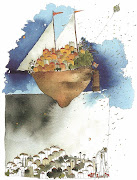
´CIII - "Quincas Borba", by Machado de Assis, comments by André Bandeira
This novel, published in 1891, narrates the rise and fall of Rubião, the personal male nurse of the philosopher Quincas Borba, who accompanies the terminally ill Borba and who becomes his sole heir, on condition of taking care of the philosopher's dog, named exactly as him: Quincas Borba. And this is the first joke. As it often happens in Machado de Assis's plots, the novel is full of mishaps and tricks which never manage to make all characters fall in flames, because his novels are the description of a whole world which is accomodated, while marching to the abyss or perhaps, being flooded by the abyss. The characters always manage to escape, either by their own wit, or by Destiny's generosity, but once the trick becomes effective, the story will never be the same again. Rubião, who had given the dog for adoption, before the will had been unsealed, runs desperate after the pet, in order to recover it and avoiding a tentative revoke of the will. This is the second joke. Once in possession of his newly acquired fortune, Rubião moves from Minas Gerais to the capital, involves himself in Politics, buys a fine house, sponsors lavish parties and, at a certain point, he meets a couple, Palha and his young beautiful wife, Sofia. He falls in love with her, he takes her condescence by acquiescence and goes on financing Palhas misadventures in Politics and Trade. Gradually, his fortune goes from unbalanced to bankruptcy and then to misery. He ends up mad, pretending to be Emperor, granting titles to the former friends who still acquiesce in exchanging some words with him, he drills his hallucinatory armies in the streets, followed by a pack of children, in a sort of Circus parade. And then he dies, to assuage all his fatal destiny, after being sheltered from the rain with the dog Quincas Borba. He thought he was king, he wore the crown or what he thought to be a crown on his head, and committed it to the carers, almost pronouncing the last fatal words of his mentor, the philosopher Quincas Borba: «to the winner, the potatoes!». There was a kind of parabol, by which the late philosopher used to describe the human condition: there were two tribes at the foot of two opposite slopes in a mountain. One tribe had enough potatoes to feed itself. The other one didn't. So, then, one day, the less fortunate tribe would climb up the mountain, get down to the other side, and massacre the more fortunate tribe, in order to get nourrishment. Therefore, «to the winner, the potatoes!». And that was fine and strong, according to the philosopher. I think, that Machado de Assis, who was a top official during the Empire, and went on so, during the Republic, without withdrawing the portrait of the Emperor Pedro II over his desk, chose «Quincas Borba» to describe how a wealthy, lonesome, philosophy, managed to put at its service a generous, incautious Emperor and exploit him till the end, under false seductions and unmoral shut-ups. The dog howled for three days, after Rubião death and then it died as well. And this is the third joke: no matter one could laugh or cry, it was the same. The cross above, which Rubião evoked as witness during one of his passionate tirades to Sofia and that she didn't want to stare at, went on over a hill in Rio de Janeiro, untouched by the laughs and tears of men. And that is how the novel ends. But not Machado de Assis...
Showing posts with label Brasil. Show all posts
Showing posts with label Brasil. Show all posts
13.5.12


14.3.08
D. Lula

O presidente Lula está aprendendo história. Com o Rio cheio de cartazes de D. João VI, faz confusão mesmo ao carioca lançados nos ónibus nunca a menos de 60 à hora.
Mas os assessores de Lula lembraram-no de falar do Padre António Vieira, e da CPLP e dos Braganças no discurso do Real gabinete Português de Leitura. Os assessores do presidente Cavaco e a sua esposa, professora de português, nem isso.
9.3.08
Professor como todos e Brasil
19:35 Sábado, 8 de Mar de 2008
Com palavras de ordem de "está na hora da ministra se ir embora", assobios e gritos de "rua, rua" cem mil professores fizeram, esta tarde, em Lisboa um xeque-mate a Maria de Lurdes Rodrigues. Com o Terreiro do Paço cheio e quando já estavam prestes a terminar as intervenções dos representantes das 15 organizações que coordenaram a "marcha da indignaçao", o desfile de professores continuava a chegar à Praça.
Não estivesse eu no Rio de Janeiro, em trânsito para Lisboa, estaria no Terreiro do Paço.
Sendo assim passei pelo centro do Rio. Comecei pela Candelária, onde se instalou o missionarismo nestas terras. Visitei o Mosteiro de S. Bento e a sua Igreja, momento alto do cristianismo no Brasil. Passei pelo Real Gabinete Português de Leitura no momento, onde por coincidência, estava começando o programa conjunto com os Presidentes de Portugal e Brasil . Um pouco antes, passei pela igreja de São francisco de Paula, onde a Casa imperial brasileira mandou rezar um Te Deum. No Largo do Paço, está em obras o Museu Imperial, assim como outras igrejas do período, NS do Carmo, no largo 15 de Novembro. E terminei no Museu de história nacional onde está uma admirável exposiçao sobre a transferência de D. João para o Brasil para além de outros momentos altos. MAs se não fosse isto estaria no Terreiro do Paço.
Com palavras de ordem de "está na hora da ministra se ir embora", assobios e gritos de "rua, rua" cem mil professores fizeram, esta tarde, em Lisboa um xeque-mate a Maria de Lurdes Rodrigues. Com o Terreiro do Paço cheio e quando já estavam prestes a terminar as intervenções dos representantes das 15 organizações que coordenaram a "marcha da indignaçao", o desfile de professores continuava a chegar à Praça.
Não estivesse eu no Rio de Janeiro, em trânsito para Lisboa, estaria no Terreiro do Paço.
Sendo assim passei pelo centro do Rio. Comecei pela Candelária, onde se instalou o missionarismo nestas terras. Visitei o Mosteiro de S. Bento e a sua Igreja, momento alto do cristianismo no Brasil. Passei pelo Real Gabinete Português de Leitura no momento, onde por coincidência, estava começando o programa conjunto com os Presidentes de Portugal e Brasil . Um pouco antes, passei pela igreja de São francisco de Paula, onde a Casa imperial brasileira mandou rezar um Te Deum. No Largo do Paço, está em obras o Museu Imperial, assim como outras igrejas do período, NS do Carmo, no largo 15 de Novembro. E terminei no Museu de história nacional onde está uma admirável exposiçao sobre a transferência de D. João para o Brasil para além de outros momentos altos. MAs se não fosse isto estaria no Terreiro do Paço.
22.1.08
Hoje leio Gilberto Freyre
Não significou, no caso brasileiro, o episódio de substituição da Monarquia pela República, em 89, repúdio absoluto do brasileiro ao regímen monárquico e sim a alguns dos seus característicos, entre os quais o abuso de centralização de poder, contra o qual vinham se acumulando, em numerosos brasileiros das diversas Províncias do Império, vítimas daquele abuso, ressentimentos seguidos por pendores descentralizadores ou, em têrmos políticos, federalistas. Era um abuso que poderia ter sido corrigido dentro do sistema monárquico de govêrno: a idéia, aliás, de Joaquim Nabuco: o Joaquim Nabuco naqueles dias mais revolucionário do que conservador, grande participante que fôra, de modo românticamente radical, da campanha abolicionista, também ela - essa campanha - antes expressão de um processo brasileiramente revolucionário, vindo de época pré-nacional do desenvolvimento social brasileiro, do que revolução específica no sentido convencionalmente patibular ou trágico de revolução.
( Mais em http://www.somosportugueses.com/mch/modules/icontent/index.php?page=753)
( Mais em http://www.somosportugueses.com/mch/modules/icontent/index.php?page=753)
20.1.08
Esperança --- Uma num milhão

Princesa Dona Isabel,
Mamãe disse que a senhora
Perdeu seu trono na terra,
Mas tem um mais lindo agora.
No céu está esse trono,
Que agora a senhora tem,
Que além de ser mais bonito
Ninguém lho tira, ninguém.
Cantiga popular brasileira a propósito de D. Isabel de Bragança que ao assinar a Lei nº. 3353, a Lei Áurea (lei de ouro), redimiu da responsabilidade de governantes dos povos português e brasileiro, que haviam escravizado os negros. Também redimia a história do Império brasileiro, cuja mancha negra fora sempre a ESCRAVIDÃO. Por fim, remia a todos os negros do Brasil, os que ainda se encontravam no cativeiro - cerca de 600 a 700 mil -, mas a todos, que passavam a CIDADÃOS BRASILEIROS.
Subscribe to:
Posts (Atom)